
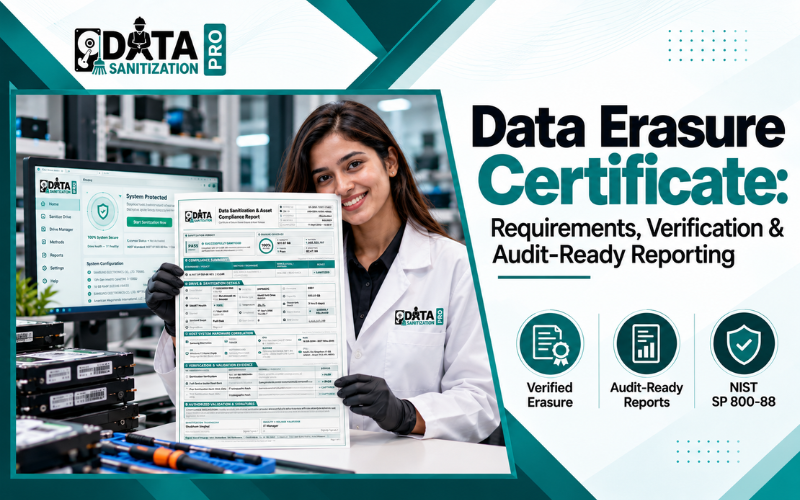
When a company retires a laptop, hard drive, SSD, server or other storage device, deleting files is not enough. The organization also needs evidence showing how the data was handled and what happened during the sanitization process.
A Data Erasure Certificate is a document that records the sanitization operation performed on a specific storage device. It can identify the device, show the method used, record the verification result and provide information for asset management and audits.

This documentation is useful for enterprises, IT asset disposition (ITAD) providers, data centers, refurbishers, e-waste recyclers and electronics recycling companies. It helps connect a physical device to its processing record, even when hundreds or thousands of devices are handled together.
However, not every certificate provides the same level of evidence. A basic document may show only that a job was completed. A more detailed certificate can include device identifiers, software and method details, timestamps, verification information and report-validation features.
Data Sanitization Pro supports data erasure workflows and reporting for compatible storage devices. Its published sample certificates show how device information, sanitization details, verification results and validation information can be documented.
This guide explains what a data erasure certificate should contain, how verification and validation differ, what NIST SP 800-88 Rev. 2 means for documentation and how to evaluate data erasure software before choosing a solution.
1. What Is a Data Erasure Certificate?
A Data Erasure Certificate is a report documenting the outcome of a data sanitization operation on a particular storage device.
It may also be called a data wiping certificate, certificate of erasure or certificate of sanitization. The exact terminology depends on the organization, service provider and applicable process.
A useful certificate answers five basic questions:
- Which device? Identifies the storage media using available hardware details.
- Which method? Records the sanitization method or standard selected.
- When? Records relevant processing timestamps.
- What was the result? Shows the recorded status and applicable verification outcome.
- Who performed the operation? Identifies the operator or organization where required.
For example, if a company processes 300 SSDs before resale, the certificate should help identify the individual drive associated with each result. A single statement saying that all 300 drives were processed may not provide sufficient detail for device-level reconciliation.
A certificate is evidence of the operation documented. Its reliability depends on the method performed, the verification process, the information recorded and the organization’s requirements.
2. Why Is a Data Erasure Certificate Important?

Device-level traceability
Make, model, serial number, capacity and asset identifiers help link the certificate to the correct device. This is particularly important when many similar drives are processed in one batch.
Audit and customer evidence
A detailed certificate helps an organization explain how a device was handled when a customer, auditor or internal reviewer asks for the processing record.
Reuse and resale
When a device is suitable for reuse, an appropriate sanitization process can help prepare it for redeployment, refurbishment or resale. The certificate records the outcome of that process.
Accountability
Operator information, timestamps, method details and error records help establish a clearer history of the operation.
Better asset management
Per-device reports can be matched with inventory lists, collection records and final asset destinations. This helps identify devices with missing certificates or incomplete processing.
Support for information-security procedures
Certificates can support an organization’s media-disposal and information-security controls. They do not, on their own, prove compliance with every law, regulation or certification scheme.
3. What Information Should a Data Erasure Certificate Include?
The required information depends on the media, the selected sanitization method, the organization’s policy and the applicable documentation requirements.
A practical certificate checklist includes the following.
Certificate information | Why it matters |
Unique report ID or UUID | Helps retrieve the record |
Manufacturer and model | Identifies the hardware |
Serial number or asset tag | Connects the report to a particular device |
Media type and capacity | Describes the storage processed |
Host-system details | Helps connect the drive to its originating computer |
Software name and version | Records the tool used |
Sanitization standard and method | Documents the selected procedure |
Start time, end time and duration | Records when processing occurred |
Processing status | Shows the reported outcome |
Verification information | Documents the applicable verification result |
Operator or responsible person | Supports accountability |
Organization and location details | Helps establish operational context where required |
Error and exception details | Identifies incomplete or unsuccessful operations |
Signature or integrity-validation details | Helps assess report authenticity and integrity where supported |
Additional device-specific fields may be appropriate.
For computers and mobile devices, these may include hardware identifiers, firmware information, chassis details, UUIDs, IMEI values or mobile-device management status, where relevant and available. A report should include only information appropriate to the device and workflow.
Storage-specific details may include interface, sectors processed, drive-health indicators, remapped-sector information or other diagnostic information when the software captures them.
Three categories of certificate information
Erasure results: method, standard, status, verification details, timestamps and error information.
Asset details: manufacturer, model, serial number, capacity, firmware and relevant host-system identifiers.
Report details: unique report ID, software version, operator information, generated timestamp and applicable signature or validation information.
Not every field is mandatory for every operation. Organizations should define the minimum evidence they require and check whether the software provides it.
To see how these details can be presented, review the sample Data Erasure Certificates and reports.
4. Data Erasure Certificate vs. Certificate of Destruction
These documents may be related, but they should describe what actually happened to the device.
Process | What happens | Typical documentation |
Software-based erasure | A supported sanitization process is performed on the storage media | Data Erasure Certificate |
Cryptographic erase | Access to encrypted data is made infeasible through an appropriate cryptographic process | Certificate or report documenting the operation |
Degaussing | A strong magnetic field is applied to suitable magnetic media | Destruction or processing record, as applicable |
Shredding or disintegration | Storage media is physically broken into pieces | Certificate of Physical Destruction |
Software-based erasure may allow the device to remain usable. Physical destruction generally prevents the destroyed media from being reused as a functioning drive.
Degaussing is not suitable for every storage technology, particularly flash-based SSDs. Shredding and other physical destruction methods also need to be appropriate for the media and the required outcome.
If a drive fails verification, it should be isolated and handled under the organization’s remediation procedure. Another suitable sanitization method or physical destruction may be required, depending on the circumstances.
A certificate should never describe software erasure as physical destruction unless a separate destruction process actually took place.
5. NIST SP 800-88 Rev. 2 and Sanitization Documentation
NIST SP 800-88 Rev. 2, Guidelines for Media Sanitization, was published in September 2025 and superseded Rev. 1. It provides guidance for establishing a media-sanitization program and selecting appropriate techniques and controls based on information sensitivity and the media involved.
The publication includes an example certificate of sanitization in Appendix C. Organizations can use the guidance to develop documentation appropriate to their own policies and operations.

Relevant documentation information includes:
- Media manufacturer, model and serial number
- Media source and type
- Operational or damaged status, where applicable
- Sanitization method and technique
- Software or tool used, including version
- Details of the person performing sanitization
- Verification or status information
- Validation or concurrence information, where applicable
- Date, location and other required personnel details
The exact information needed depends on the operation and the organization’s procedures. A software report may automatically capture device and processing information, while responsible personnel may need to complete other fields.
Why the current revision matters
Older templates and internal procedures may refer to Rev. 1. Organizations should review their documentation against Rev. 2 and update their processes where necessary.
A certificate that names a standard should accurately identify the method and revision used. Simply printing “NIST compliant” on a document does not demonstrate that the operation met the relevant requirements.
NIST guidance is also not the same as independent certification of a software product. A product’s support for a sanitization method should not be presented as proof that NIST has certified or endorsed the product.
Official reference: NIST SP 800-88 Rev. 2 — Guidelines for Media Sanitization.
Organizations can also review the Data Sanitization Pro standards resource when assessing relevant sanitization methods.
6. Verification vs. Validation
Verification and validation are related, but they serve different purposes in a sanitization program.
What is verification?
Verification checks the result of the sanitization operation using the applicable process. It helps determine whether the operation produced the expected result.
The technique depends on the method, media and requirements. A job reaching 100% completion does not automatically mean that all required verification checks passed.
What is validation?
Validation is the assessment of whether the sanitization process and its result are acceptable for the intended purpose, based on the applicable criteria and organizational procedure.
This may involve reviewing the recorded result, method, media condition and other relevant information.
Why the difference matters
A useful certificate should not blur the distinction between a process completing, a verification check passing and an authorized person accepting the result.
For example, if a device reports an error or does not satisfy the required verification criteria, the certificate should preserve that outcome. The organization can then determine the next action according to its procedure.
7. Digital Signatures, Hash Values and Report Integrity
A data erasure certificate is more useful when reviewers can assess whether the report is authentic and whether its contents have changed since signing or generation.
Three concepts are important.
Digital signatures
A properly implemented digital signature can help establish the origin and integrity of signed content. When a signed document is modified, signature validation should detect that the content no longer matches the signed version.
However, a digital signature is not a promise that a file can never be edited. It provides a way to detect changes to the signed content when validation is correctly implemented.
Organizations should keep the original digital report rather than relying only on a scanned printout and should retain the means needed to validate the signature.
Cryptographic hash values
A cryptographic hash creates a fixed-length digital fingerprint of a defined input.
Pre- and post-sanitization hash fields may provide useful evidence, but their meaning depends on exactly what was hashed and when. If the entire content of a drive is hashed before and after erasure, the values would normally differ because the content has changed.
A hash value alone does not prove that all storage locations were sanitized. The certificate or supporting documentation should explain what was hashed and how the result relates to the verification process.
Report IDs and audit trails
A unique report identifier helps retrieve the correct record. Timestamps, operator details and device identifiers help connect the report with the processing event.
Together, these details can improve traceability, especially when the original report is retained and validation procedures are documented.
What to check before relying on a certificate
- Is the device identified clearly?
- Does the report state the method used?
- Is the actual processing result recorded?
- Is the verification outcome clear?
- Are hash values explained?
- Can the signature or integrity information be validated?
- Are errors and exceptions recorded?
- Is the original report retained securely?
8. How to Manage Certificates for Large Device Batches
Managing a few certificates manually may be simple. Managing thousands of devices across multiple facilities requires a more consistent process.
Use a unique record for each device
Every certificate should be linked to the correct asset identifier and processing result. Similar model names or storage capacities are not enough to distinguish individual drives.
Reconcile certificates with inventory
Compare the number of devices received, processed, passed, failed and released. Investigate missing certificates, duplicate records and devices whose status remains unresolved.
Store original reports securely
Define where certificates will be stored, who can access them, how long they must be retained and how they can be retrieved during an audit.
Plan for batch reporting
For high-volume operations, evaluate whether the software supports efficient export, search, centralized storage and batch reconciliation. These capabilities should be confirmed against the product’s actual features.
Keep failures visible
Do not remove failed or incomplete jobs from the record simply because they complicate the final report. Record their status and the action taken.
Integrate with asset workflows where needed
Organizations may want to connect erasure records with asset-management, ticketing or IT service-management systems. Check integration availability and data formats before selecting a solution.
9. What Happens When Erasure Fails?
A device may be disconnected, damaged, incorrectly identified or unable to complete the selected sanitization procedure. Verification may also produce an unsuccessful result.
A responsible workflow should:
- Record the failed or incomplete result.
- Preserve relevant error and verification information.
- Confirm the device identity and assess the cause.
- Follow the organization’s remediation procedure.
- Apply another suitable method where appropriate.
- Use physical destruction if required by the policy or if an acceptable sanitization outcome cannot otherwise be achieved.
- Update the asset record with the final outcome.
A failed operation must not be presented as a successful erasure.
The certificate is only one part of the process. The organization also needs a defined procedure for handling exceptions and ensuring that devices are not released before the required outcome has been achieved.
10. How Data Sanitization Pro Supports Certificate Reporting
Data Sanitization Pro provides data sanitization workflows and reporting for compatible storage devices. Its published sample-report page allows prospective users to inspect the certificate format before evaluating the software.
The sample certificate information includes fields such as:
- Report ID and job ID
- Generated timestamp and processing duration
- Sanitization status
- Standard and method
- Verification details
- Asset and drive information
- SMART information, where available
- Operator and organization information
- Host-system details
- Validation information
- Pre- and post-sanitization hash fields
The exact information depends on the device and workflow. Organizations should inspect the report and confirm that it meets their requirements.
Review the sample certificate before choosing software
A sample certificate helps you assess whether the document identifies the correct device, describes the method used and records the outcome clearly.
It also allows your IT, security or compliance team to check whether the available fields are suitable for its internal process.
View the Data Sanitization Pro sample certificates and reports.
Explore Data Sanitization Pro certificate services.
Explore data sanitization standards.
11. Who Needs Data Erasure Certificates?
Enterprises and corporate IT teams
Document the sanitization of retired employee laptops, desktop computers, HDDs, SSDs and servers.
ITAD providers
Connect device-level processing results with inventory, custody records and final asset disposition.
Data centers
Maintain evidence when storage devices are removed during server replacement, migration or decommissioning.
Refurbishers and resellers
Keep records of sanitization operations before devices are prepared for resale or redeployment.
E-waste and electronics recyclers
Document the handling of data-bearing equipment before reuse, resale or recycling.
Government and regulated organizations
Maintain records as part of broader asset-disposal and information-security procedures.
Healthcare, banking and financial services
Support documented media-handling processes for devices that may contain sensitive or regulated information.
The required documentation depends on the organization’s role, contracts, policies and applicable legal or regulatory requirements.
12. How to Choose Data Erasure Certificate Software
Before purchasing a solution, use this checklist.
- Device identification: Can it identify individual drives and relevant host systems?
- Method transparency: Does it record the method and standard actually used?
- Verification: Does it show the applicable verification result?
- Failure handling: Are errors and unsuccessful operations recorded?
- Digital signatures: Is the signature-validation process documented?
- Hash information: Is the meaning of pre- and post-sanitization hashes clear?
- Standards support: Are the supported methods appropriate for your media and requirements?
- Sample reports: Can you inspect actual certificates before purchasing?
- Batch management: Can records be reconciled across large device volumes?
- Offline operation: If required, can the software perform the necessary workflow without internet connectivity?
- Retention and retrieval: Can the organization store and retrieve reports securely?
- Evidence quality: Does the report provide enough detail for your internal reviewers and customers?
Do not evaluate software only by the number of methods it lists or the appearance of its dashboard. The quality, clarity and verifiability of its output matter too.
Conclusion
A Data Erasure Certificate should do more than state that a device was wiped. It should connect the physical asset to the sanitization method, processing outcome and available verification evidence.
Device identifiers improve traceability. Timestamps and operator details support accountability. Verification records document the result, while digital signatures and cryptographic hashes can provide additional integrity information when correctly implemented and interpreted.
For large-scale operations, reliable certificate management also requires inventory reconciliation, secure report retention and a clear process for failed or incomplete jobs.
Data Sanitization Pro supports sanitization workflows and reporting for compatible storage devices. Reviewing its sample certificates is a practical way to determine whether the available information meets your organization’s requirements.
Identify the device. Select the right method. Verify the result. Document the evidence.
Explore Data Sanitization Pro’s sample reports to review the available certificate formats and reporting information.
Frequently Asked Questions
What is a Data Erasure Certificate?
It is a document recording the sanitization operation performed on a specific storage device, including relevant device details, method and recorded outcome.
What is the difference between a Data Erasure Certificate and a Certificate of Destruction?
A data erasure certificate documents a sanitization operation. A certificate of physical destruction documents the actual destruction of the storage media.
What should a Data Erasure Certificate include?
Useful fields include manufacturer, model, serial number, capacity, method, software version, timestamps, processing status, verification details and responsible-person information.
Is a digital signature enough to prove that a drive was erased?
No. A digital signature can help validate report integrity, but it does not independently prove that the sanitization operation succeeded. The method, verification result and supporting evidence must also be reviewed.
Do pre- and post-sanitization hash values prove successful erasure?
Not by themselves. Their meaning depends on what was hashed and how the values were generated. They should be interpreted alongside the sanitization method and applicable verification process.
Does NIST SP 800-88 Rev. 2 provide certificate guidance?
Yes. Rev. 2 includes an example certificate of sanitization in Appendix C. Organizations should apply the guidance within their own media-sanitization program and documentation procedures.
Are data erasure certificates legally required for every device?
Requirements vary by law, industry, contract, certification scheme and organizational policy. A certificate can support evidence collection, but organizations should determine the documentation required for their circumstances.
What happens when a drive fails verification?
The failed result should be recorded and handled under the organization’s remediation procedure. Another suitable method or physical destruction may be required before the asset can be released.
Can certificates support bulk ITAD operations?
Yes. Per-device reports can be reconciled with inventory and custody records, helping organizations track completed jobs, exceptions and final asset destinations.
Where can I see a sample Data Sanitization Pro certificate?
Visit the Data Sanitization Pro sample reports page to review the published sample certificates and reports.


